Rare diseases
Diagnosing rare diseases sooner
A rare disease can take years to be recognised and diagnosed. We fund the practical work that shortens that wait, from education to clearer referral routes for available treatments.
Around 3.5 million people in the UK live with a rare condition. Individually these conditions are uncommon; counted together they are not. Yet because each one affects small numbers, the tests and treatments that would help are rarely commercially attractive to drug developers.
The result is what families call the diagnostic odyssey: years of doctor and hospital appointments, repeated tests and still no name for what is happening. A diagnosis does not always change the treatment, but it almost always changes their future — it ends the uncertainty, opens the door to support, and connects families to others in the same position.
Duet backs the unglamorous work that shortens that wait. Validating a test so it can be used outside a specialist centre. Funding the pilot data a larger funder will later ask for. Paying for a clear leaflet that answers the questions parents actually have.
What we look for
- Simpler, quicker diagnostic tests that can be used outside specialist centres
- Studies small enough to be passed over by commercial funders, but big enough to change patient care
- Plain-English information and support for families waiting for answers
Working in this area?
Duet is running its own projects at the moment, so we are not inviting funding applications. We are always glad to hear from researchers, clinicians and patient organisations working on rare conditions.
Get in touchCurrent Projects
Raising awareness of rare eye diseases
After more than 30 years professionally involved in developing treatments for rare diseases, one of our Founders, Julie Matthews, has recently been diagnosed with a rare eye disease herself - Salzmann Nodular Degeneration (SND)¹.
SND manifested as a rapid and significant decline in Julie's eyesight.
It seems that opticians, and even clinical ophthalmologists, may often be either unaware (or are not actively looking for) this or other rare eye diseases.
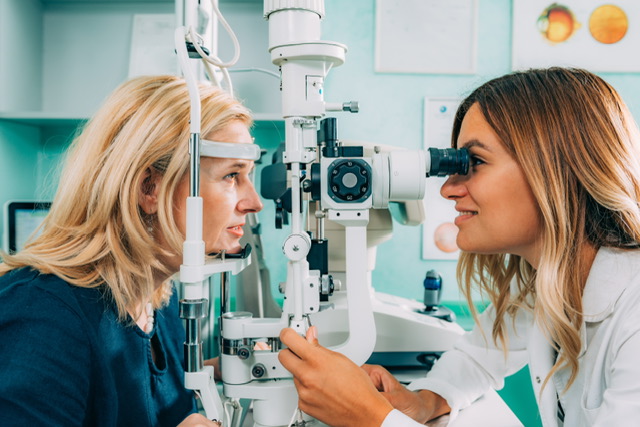
Thus, the first consultant ophthalmologist Julie saw was sympathetic, but after a slit-lamp examination said Julie's cornea was 'just distorted' and nothing could be done.
Luckily, Julie and Mike decided they should get a second opinion, this time from a corneal expert.
The corneal expert, Mr Thomas Poole, of Frimley Park Hospital, repeated Julie's slit-lamp exam and immediately diagnosed SND.
"I can help you" he said.
Four wonderful words — and, soon afterwards, a relatively simple surgical procedure corrected the issue.
Hence Duet Health is including in our list of key 'Missions' the raising of awareness of SND and other rare eye diseases. Duet Health will support educational meetings for local opticians and ophthalmologists, to be spearheaded by our corneal expert and his colleagues.
¹ Paranjpe V, Galor A, Monsalve P, Dubovy SR, Karp CL. Salzmann nodular degeneration: prevalence, impact, and management strategies. Clin Ophthalmol. 2019 Jul 25;13:1305-1314. doi: 10.2147/OPTH.S166280. PMID: 31413538; PMCID: PMC6663077.
Small charity, practical help
Duet is funded by our Founders and by people who believe useful research should not stall for want of a modest amount of money. Every gift goes into projects.